
Cass County Court Records After Arrest
In Cass County, Michigan, the court record after a jail arrest is not the same thing as the jail booking record. The booking record is created by the Cass County Sheriff's Office when a person is received at the Cass County Jail. The court record starts when the government, through the prosecuting attorney, files a complaint against the defendant. Cass County Courts explains that if the defendant has not already been arrested, an arrest warrant issues when the complaint is filed. If the person has already been booked, the complaint is the bridge from custody into the public case file.
The local court path has two main public search points. The MiCOURT 4th District Court search is the place to begin for district criminal and traffic matters, including arraignments and preliminary felony steps. The MiCOURT 43rd Circuit Court search is used for felony-level circuit matters after bindover and for other circuit court criminal proceedings. For the jail side of the same event, the Cass County jail inmate records page covers custody status, VINE, and jail phone fallbacks. Booking photos and photo requests are handled separately on the Cass County jail mugshots page.
Michigan counties use a prosecuting attorney, not a district attorney. Cass County's Prosecuting Attorney's Office is in the Law and Courts Building in Cassopolis. The 2025 county telephone directory listed Victor A. Fitz, but Cass County later reported that Fitz resigned. A county news item dated May 28, 2026 says Circuit Court Judge Mark A. Herman appointed Sarah E. Scoggin as Interim Prosecuting Attorney, with service in that interim role until an appointment fills the balance of the prior prosecutor's term.
Find Cass County Court Records
Cass County court records after a jail arrest should be searched by court level and case stage. District Court is usually where the first formal hearing takes place after arrest on a felony or high-court misdemeanor. Cass County Courts says the judge or magistrate explains the charges, constitutional rights, possible penalties, and bond. For felony and high-court misdemeanor cases, the preliminary examination also starts in District Court. If probable cause is found, the case is bound over to Circuit Court for trial or later resolution.
- Start with the Cass County Courts criminal-case information and identify whether the case is still in 4th District Court or has moved to 43rd Circuit Court.
- Search MiCOURT D04 for district matters, especially arraignment, bond, misdemeanor, traffic, and preliminary-exam entries.
- Search MiCOURT C43 if the case is a felony after bindover, a circuit-level criminal matter, or a later plea, trial, or sentencing event.
- Use the case number, defendant name, and hearing entries to compare each charge, status change, bond entry, and disposition.
- Call the court file room if the online record is unclear or if a document must be inspected through court channels.
The Cass County Courts home page links case lookups and live dockets. The court site states that docket schedules are updated every 30 minutes and are subject to change without notice. Court file rooms provide a direct fallback: 4th District Court file room at 269-445-4424 and 43rd Circuit Court file room at 269-445-4416. The public service windows listed by Cass Courts are separate from the jail's custody functions, so a court question should go to the court, not to jail staff.
The manifest includes a screenshot of the Cass County 4th District Court MiCOURT search page, which is the court-level entry point for many post-arrest records.
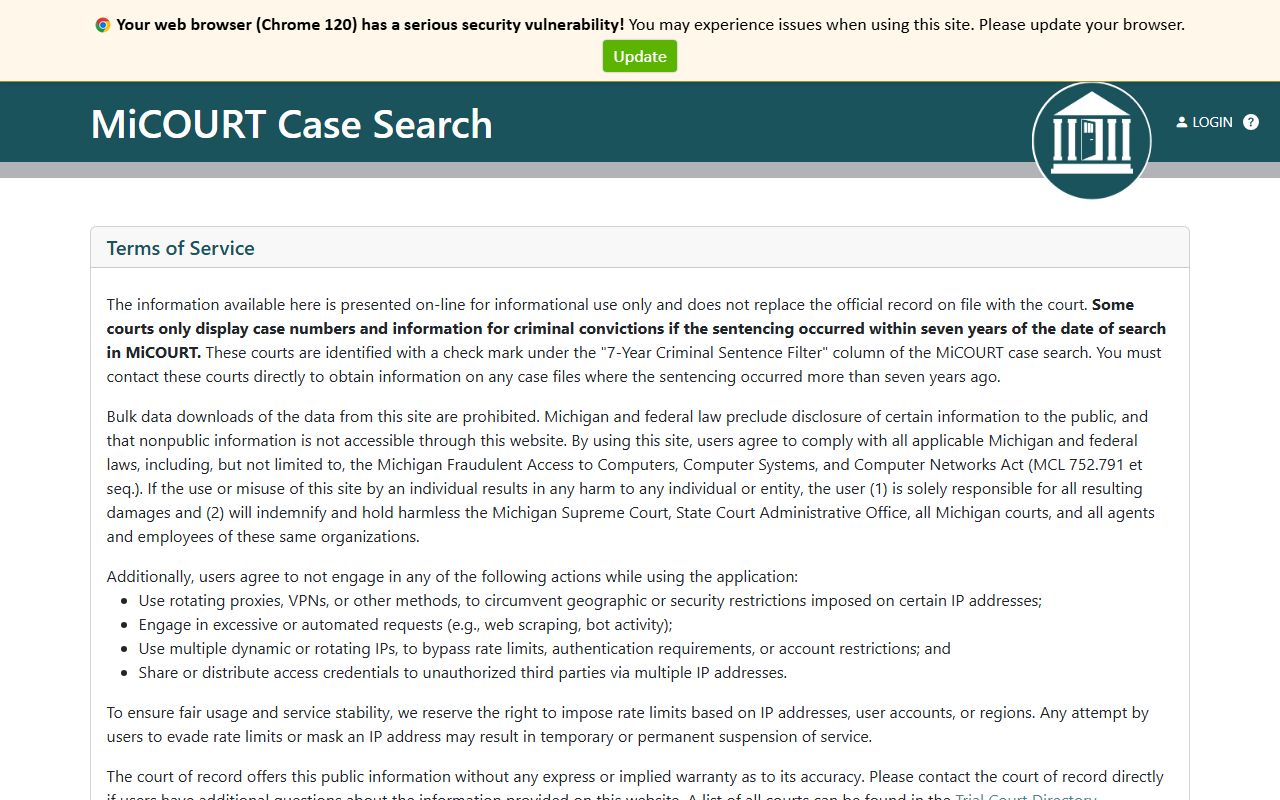
Use that court-specific search path for filed criminal cases rather than treating the jail custody system as the official charge-status source.
Cass County Arrest Charging Documents
The charge record after a Cass County jail arrest begins with a charging document. Cass County Courts describes the complaint as the filing that starts a criminal case. In felony and high-court misdemeanor matters, the case begins in District Court, where arraignment and preliminary examination occur. If enough evidence supports probable cause, the case is transferred to Circuit Court. At that point, circuit proceedings may include another arraignment unless it is waived, then plea, trial, dismissal, or sentencing.
| Document | Plain meaning | Cass County record use |
|---|---|---|
| Complaint | The prosecutor's formal accusation that starts the criminal case. | Cass Courts says the government begins a case by filing a complaint; if no arrest has occurred, a warrant issues when it is filed. |
| Information | A felony charging document used after preliminary examination or waiver. | Common in circuit-level felony cases after bindover from 4th District Court to 43rd Circuit Court. |
| Indictment | A charge returned through a grand-jury process. | Less common in ordinary local prosecution, but it is still a charging-document type rather than a jail booking record. |
A booking entry can list arrest allegations, hold reasons, or warrant details. The complaint or later information controls the formal court accusation. That difference matters when a person sees one label in custody information and another label in MiCOURT. The filed case may narrow, add, or correct charges after the jail intake event.
Cass County Charge Status
Charge status is the best way to read court records after a jail arrest without assuming too much from the first booking entry. Cass County criminal cases can resolve by bench trial, jury trial, plea agreement, dismissal, or sentencing. Before that happens, charges may be pending, amended, reduced, dismissed, or bound over to Circuit Court. A charge is an accusation. It is not proof of guilt.
| Status | What it means | Where it may appear |
|---|---|---|
| Pending | The charge is open and has not yet reached plea, trial, dismissal, or sentencing. | MiCOURT case entries and live docket listings. |
| Amended or reduced | The prosecutor or court record shows a changed charge, level, or description. | Complaint amendments, plea entries, or updated case records. |
| Dismissed | The court record shows the charge or case ended without a conviction on that charge. | Disposition entries or written orders. |
| Bound over | A felony or high-court misdemeanor moved from District Court to Circuit Court after probable cause or waiver. | District Court and Circuit Court records. |
| Convicted | A plea or trial resulted in a conviction, followed by sentencing or other court orders. | Circuit or District Court disposition and sentencing entries. |
MiCOURT is a public case-search portal, but the research did not capture every exact field label in the JavaScript interface. Use precise terms shown in the case record rather than guessing. If a case status affects release, bond, a warrant, or a deadline, confirm it with the appropriate court file room or with counsel.
Bond After Cass County Arrest
Bond connects the jail record and the court record. Cass County's inmate-services page says many arrested inmates are booked and given a set bond amount for release, while some must be arraigned in front of a judge. The research notes that arraignments occur weekday afternoons. Once arraignment happens, District Court controls whether release on bond is allowed and what amount or conditions apply. A personal recognizance bond means release on a promise to appear. A cash bond requires payment. A no-bond hold means local payment alone will not release the person.
| Bond type | How it works | Cass County note |
|---|---|---|
| Personal recognizance | No upfront cash, but the defendant must return to court and follow conditions. | The court sets the terms, not the jail. |
| Cash bond | Cash must be paid under the court's order. | Cass County says cash bond can be paid at the Sheriff's Department at any time. |
| 10 percent bond | A percentage deposit is accepted only if the court ordered that form. | Confirm eligibility before paying. |
| Surety bond | A surety or bail agent posts under court conditions. | No Cass-specific bondsman process was located in official research. |
| No-bond hold | No release from local custody based on payment alone. | Check for another warrant, probation or parole hold, federal hold, or other agency detainer. |
Cass County lists a $12 booking fee under the inmate-services page and Michigan law, plus a $10 warrant fee if the person was arrested because of a warrant. The local page says those fees are added to the bond amount and must be paid before bond release. Bond can be paid online through Express Account when eligible, or in cash at the Sheriff's Department.
Cass County Bench Warrants
No official Cass County public active-warrant database was located in the research. That does not mean a warrant does not exist. Cass County Courts warns that a person who does not see a name online but believes they should be in court should call the court to verify the date. Failure to appear can result in a bench warrant, dismissal, or action without the person's input. A bench warrant is a court order issued because a person missed court or violated a court requirement.
For warrant-related court records after an arrest, use MiCOURT and the court file rooms. For law-enforcement records, use the Cass County Sheriff's FOIA process. If a person was arrested on a warrant, the jail may assess the local warrant fee noted by Cass County. A warrant can also block release if another court, county, probation office, federal agency, or immigration authority has placed a hold.
Note: Confirm warrant questions directly with the court or an attorney before appearing, and do not send informal payments to callers.
Cass County Charges vs Convictions
A Cass County court record after a jail arrest can contain accusations long before it contains any final result. The distinction is simple but important. An arrest means a person was taken into custody. A charge means the prosecutor has filed or pursued an accusation in court. A conviction means guilt was established by plea or trial. Until that point, the charge remains an allegation, even if the person was booked, photographed, held on bond, or listed in a court docket.
| Record point | Charge | Conviction |
|---|---|---|
| Stage | Accusation after complaint or later amendment. | Final result after plea, bench trial, or jury trial. |
| Proof level | Filed based on legal accusation and probable-cause standards. | Requires guilt by plea or proof beyond a reasonable doubt at trial. |
| Case effect | Can be pending, amended, reduced, dismissed, or bound over. | Can lead to sentencing, fines, probation, jail, prison, or other orders. |
| Search source | MiCOURT, court docket, complaint, and court file room. | MiCOURT disposition, sentencing entry, and court file. |
Cass County Sealed Records
Sealed and expunged records are not the same. Michigan's set-aside law, MCL 780.621, governs adult conviction set-aside applications. Michigan State Police also publishes Clean Slate information for automatic and application-based set-asides. A set-aside can limit public access to qualifying criminal-history records, but it does not mean every trace of an arrest or every third-party copy vanishes at once.
| Issue | Sealed or restricted | Set aside or expunged |
|---|---|---|
| Public visibility | Public access is limited by law or court rule. | Qualifying conviction records are treated under Michigan set-aside rules. |
| Law-enforcement access | May still be available to certain agencies or courts. | May remain available for limited government purposes. |
| Eligibility | Depends on record type, juvenile status, court order, and exemptions. | Depends on Michigan Clean Slate and MCL 780.621 criteria. |
| Best next step | Ask the court file room what can be viewed by the public. | Use MSP Clean Slate material or legal counsel for eligibility questions. |
Juvenile custody and juvenile court records require special caution. Michigan law limits when minors may be held in jail or lockup settings, and juvenile records often follow access rules different from adult criminal cases. Ongoing investigations, custodial security, and certain law-enforcement materials may also be withheld or redacted under Michigan FOIA exemptions.
Cass County Court vs Jail Records
Court records and jail records answer different questions after the same arrest. VINE and the Cass County Jail phone can help with custody status, location, release, transfer, or whether a person is still housed locally. MiCOURT and the Cass County Courts file rooms answer charge, hearing, warrant, disposition, and sentencing questions. The prosecutor's complaint and later court entries are the formal charge path. The jail's booking process is the custody path.
- Booking
- Administrative jail intake after arrest, including identity, custody entry, fees, and basic processing.
- Arraignment
- The first court appearance where charges, rights, possible consequences, and bond are addressed.
- Preliminary examination
- A District Court probable-cause hearing in felony and high-court misdemeanor cases, normally held within 14 days of arraignment under the Cass Courts explanation.
- Bindover
- Transfer from District Court to Circuit Court when probable cause is found or the hearing is waived.
- Detainer
- A hold from another agency or jurisdiction that can prevent release even when local bond is paid.
The manifest also includes the Cass County 43rd Circuit Court MiCOURT search page for circuit-level records after bindover.
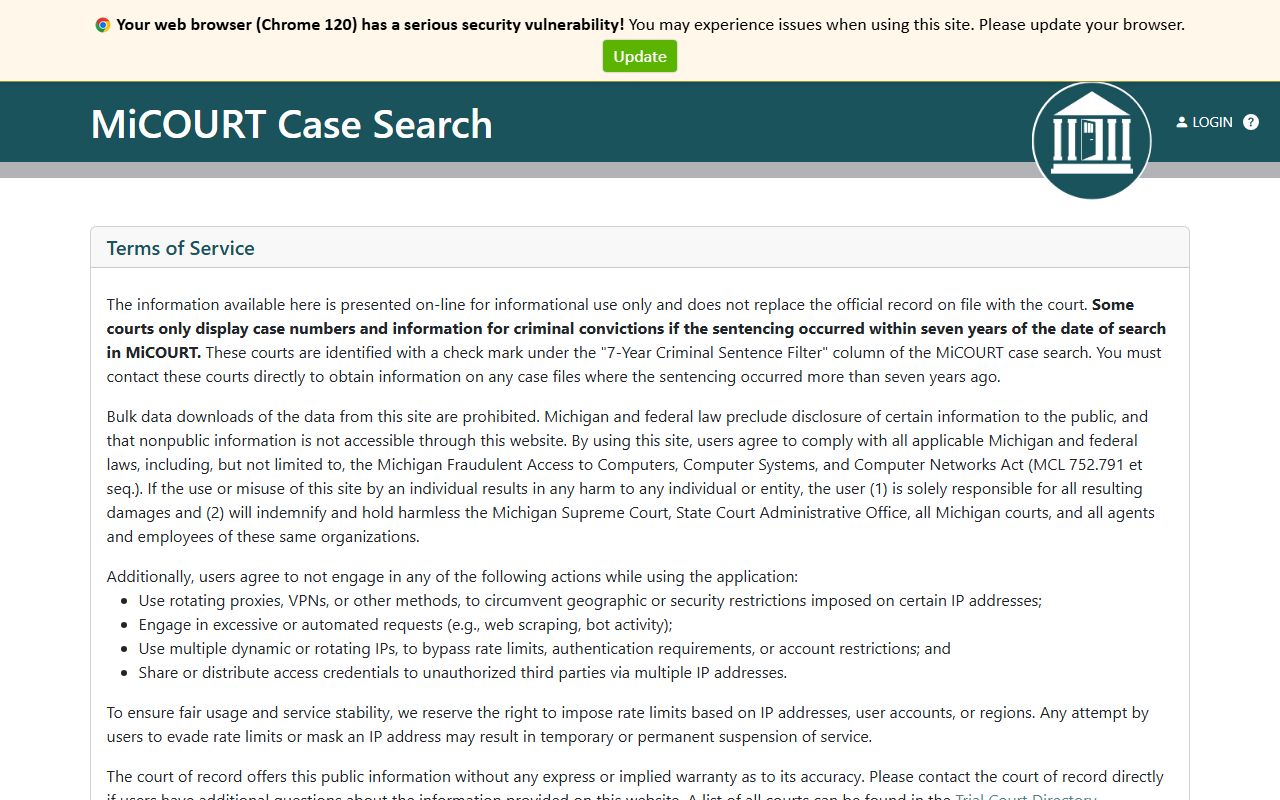
Use the circuit search when the court record shows a felony matter has moved beyond the district-court stage.
Restricted Cass County Arrest Records
Michigan FOIA begins with a broad public-records policy in MCL 15.231, but access is not unlimited. MCL 15.243 allows withholding or redaction for specific exemptions, including certain law-enforcement information and records whose release would affect the physical security of a custodial or penal institution. Court records may also be restricted by rule, statute, juvenile status, or order.
For Cass County court records after a jail arrest, start with the public MiCOURT entries, then ask the correct court file room about documents that are not online. For Sheriff's Office arrest reports, booking sheets, or jail records, use the Sheriff's FOIA form or sherifffoia@cassco.org. Requests should describe the record with enough detail, such as name, arrest date, case number, incident number, and the exact document sought.
Important: Public court and custody lookups are not consumer reports and should not be used for credit, employment, insurance, housing, or other FCRA-covered decisions.